
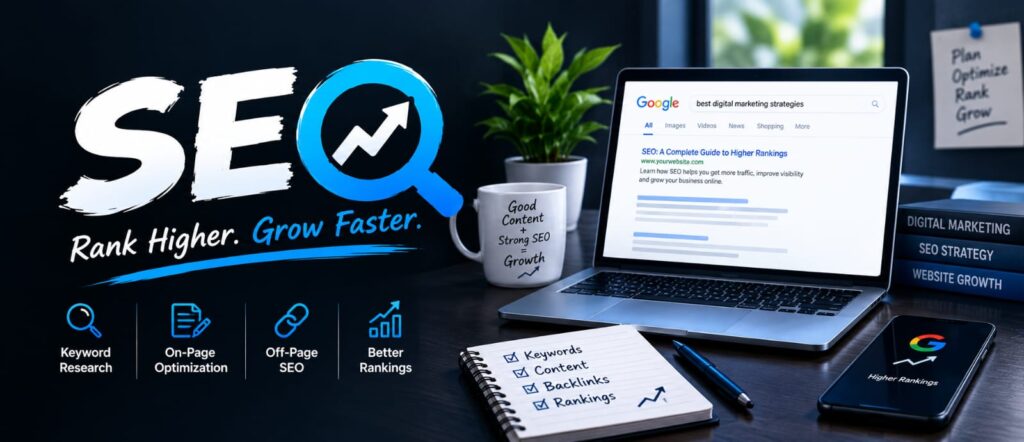
SEO (Search Engine Optimization):
When someone searches for a product, service or piece of information they rarely scroll past the first page of results. Search Engine Optimization (SEO) is the practice of improving a website so it ranks higher on search engines like Google making it easier for potential customers to find you organically—without paying for ads.
>What is SEO?
SEO is the process of optimizing a websites content, structure and technical elements so search engines can understand, index and rank it favorably for search queries. Good SEO helps a website appear higher in search results driving organic (unpaid) traffic over time.
>Benefits of SEO
1. Increased Organic Traffic – Higher rankings mean more people discover your website naturally without paid promotion.
2. Cost-Effective Long-Term Growth – Unlike paid ads that stop working the moment you stop paying SEO delivers results once established.
3. Builds Credibility and Trust – Users tend to trust websites that rank higher associating positions with authority and reliability.
4. Better User Experience – SEO practices (fast loading, mobile-friendliness clear navigation) improve the overall experience for visitors.
5. Higher Conversion Rates – visitors who find you through relevant searches are often more likely to convert into customers.
6. Competitive Advantage – Outranking competitors in search results captures the audience they might otherwise reach.
>Advantages of SEO Over Other Marketing Channels
– Results – SEO gains compound over time unlike ads that disappear the moment budgets run out.
– Targets High-Intent Users – People searching for specific terms are often ready to buy or engage making traffic more valuable.
– Improves Brand Visibility – Appearing frequently in search results reinforces brand recognition among users who don’t click through.
– Works Around the Clock – An optimized website continues attracting visitors 24/7 without ongoing manual effort.
– Measurable and Data-Driven – Tools like Google Search Console and Analytics provide insight into whats working.
– Supports Other Marketing Efforts – Strong SEO content can be repurposed for social media, email campaigns and paid ads.
>The SEO Process
1. Keyword Research
Identify the words and phrases your target audience uses when searching, focusing on relevance, search volume and competition level.
2. On-Page Optimization
Optimize individual pages—titles, headings, meta descriptions, images and content—to align with target keywords and improve relevance.
3. Technical SEO
Ensure the websites backend is search-engine fast loading speed, mobile responsiveness, secure (HTTPS) clean URL structures and proper indexing.
4. Content Creation
Develop high-quality content (blogs, guides, videos) that answers user queries and naturally incorporates target keywords.
5. Link Building
Earn backlinks from websites signaling to search engines that your site is a trusted and authoritative source.
6. Local SEO (if applicable)
Optimize for location-based searches through Google Business Profile listings, local keywords and customer reviews.
7. Monitoring & Analytics
Track rankings traffic and user behavior using tools like Google Search Console to measure progress.
8. Continuous Improvement
SEO isn’t a one-time task—regularly update content, fix issues and adapt to search engine algorithm changes.
SEO is a long-term investment that pays off by making your website more visible, credible and accessible to the people searching for what you offer. While it requires patience and consistent effort the sustainable organic traffic and trust it builds make it one of the valuable strategies, in digital marketing.
Search engine optimization, SEO strategy, keyword research, on-page SEO, off-page SEO, technical SEO, backlink building, domain authority, page authority, SERP ranking, Google algorithm update, E-E-A-T, content optimization, meta description, title tag optimization, internal linking, site speed optimization, mobile-first indexing, voice search optimization, local SEO, Google My Business optimization, long-tail keywords, search intent, featured snippets, zero-click search, AI Overviews SEO, semantic SEO, schema markup, structured data, link building strategy, SEO audit, organic traffic growth, SEO trends 2026, Core Web Vitals, user experience (UX) SEO, alt text optimization, canonical tags, crawlability and indexing, anchor text, competitor SEO analysis, SEO content writing